
Minor Pentatonic Scale
The minor pentatonic scale is the five-note scale behind most rock and blues guitar solos: 1, ♭3, 4, 5 and ♭7. It is natural minor without the 2nd and ♭6th, so it has no half steps and fits over minor chords — and, in blues, over dominant 7th chords too. Pick a key to see the minor pentatonic scale on the fretboard or keyboard and hear it.

Formula
1 ♭3 4 5 ♭7
1½–W–W–1½–W
Explore the minor pentatonic scale
A Minor Pentatonic Scale
Formula · 1½–W–W–1½–W
- Root
- Scale note
The minor pentatonic scale in all 12 keys
Open the minor pentatonic scale in any key on guitar for the five boxes, or on piano for the keyboard view.
- C= E♭ major pent.
C E♭ F G B♭
- C♯= E major pent.
C♯ E F♯ G♯ B
- D= F major pent.
D F G A C
- D♯= F♯ major pent.
D♯ F♯ G♯ A♯ C♯
- E= G major pent.
E G A B D
- F= A♭ major pent.
F A♭ B♭ C E♭
- F♯= A major pent.
F♯ A B C♯ E
- G= B♭ major pent.
G B♭ C D F
- G♯= B major pent.
G♯ B C♯ D♯ F♯
- A= C major pent.
A C D E G
- B♭= D♭ major pent.
B♭ D♭ E♭ F A♭
- B= D major pent.
B D E F♯ A
Minor pentatonic scale formula
In steps the minor pentatonic scale is 1½–W–W–1½–W (three semitones, two, two, three, two). In A that gives A C D E G; in E, E G A B D. Those two are the classic guitar keys because they work with open strings.
Add one note — the ♭5 — and the minor pentatonic scale becomes the blues scale. Start the same five notes on the ♭3 and you get the relative major pentatonic: A minor and C major pentatonic are the same notes.
Minor pentatonic scale on guitar

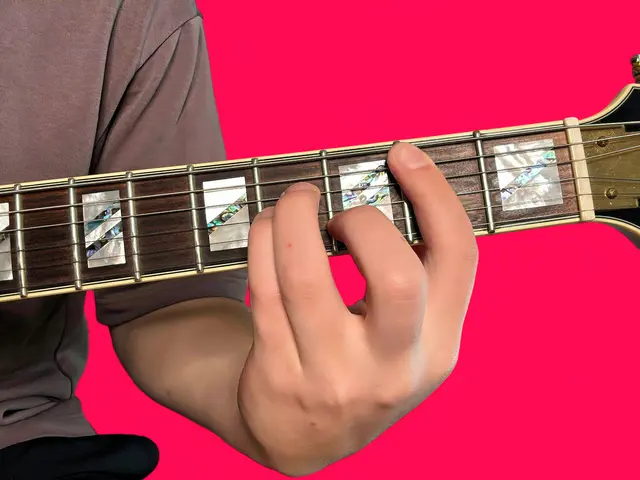
The minor pentatonic scale has five box shapes that cover the neck. Box 1, with the root under your index finger on the 6th string (fret 5 for A, open or fret 12 for E), is the one every rock guitarist learns first; the other four connect above it and the set repeats after 12 frets.
Bends are part of the sound: push the 4th up a whole step to the 5th, or the ♭7 up to the root. Every guitar scale page lets you play each box and hear it.
Minor pentatonic scale on bass
On bass the minor pentatonic scale is the first choice for rock and funk lines. Because a bass is tuned E A D G like the bottom four guitar strings, the lower half of each guitar box is a ready-made bass pattern — just an octave lower.
A one-octave bass fingering in A: on the E string, root at fret 5 (finger 1) and ♭3 at fret 8 (finger 4); on the A string, 4 and 5 at frets 5 and 7 (fingers 1 and 3); on the D string, ♭7 and the octave at frets 5 and 7 (fingers 1 and 3).
On piano and keyboard
Over a minor chord in the left hand, the right hand can play the minor pentatonic scale in almost any order. Try it in octaves for a rock-organ sound, or as rolling triplets between the 4th and 5th for a gospel-blues feel.
Two keys stand out on the keyboard. In E♭ (D♯) minor pentatonic all five notes are black keys, so the hand can fall almost anywhere; in A and E every note is a white key (A C D E G, E G A B D), which makes them the easiest to read.
Mixing major and minor pentatonic

Every minor pentatonic scale has a relative major pentatonic three half steps above its root, with exactly the same notes. Over a minor chord you hear the minor version; over its relative major chord the same shape sounds major.
In blues and country, players often mix both on the same root — the ♭3 sliding up into the major 3rd is one of the most recognisable sounds of the style. Rock players from the 1960s onward built whole solos from box 1 of the minor pentatonic scale alone, which is why the shape is often called “the rock box”.
How to practise the minor pentatonic scale
A routine that takes the minor pentatonic scale from exercise to real soloing.
- 1
Alternate picking at 60 bpm
Play box 1 of the minor pentatonic up and down with strict down-up picking, one note per click. When it is clean three times in a row, add 5 bpm. Then try eighth notes at the same tempo.
- 2
Bend to pitch
Bend the 4th on the G string up to the 5th and check it against the fretted 5th two frets higher. In-tune bends are the difference between “rock” and “wrong”.
- 3
Learn three classic licks
A ♭3–4 hammer-on, a ♭7–root bend, and a double-stop on the top two strings cover a surprising amount of rock and blues vocabulary. Move each one to every box.
- 4
Solo over a 12-bar
Loop a 12-bar blues in A and stay in box 1 for all three chords. Then switch to box 2 for the IV chord and back — your first step to moving with the harmony.
Common minor pentatonic scale mistakes
Ending phrases on random notes
Land on the root, the 5th or the ♭7 at the end of a pentatonic phrase. Stopping on the 4th leaves the listener hanging unless you mean to.
Out-of-tune bends
A bend that falls short of the target pitch sounds sour. Support the bending finger with the ones behind it and check the target note first.
Using it over every chord
Over bright major-key pop chords, the ♭3 and ♭7 can sound out of place. Switch to the major pentatonic there, or blend the two on purpose.
Too many notes
Fast runs impress for a bar; a well-placed bend and a rest say more. Count rests into your phrases as deliberately as notes.
Other scale types



Minor Pentatonic Scale FAQ

What notes are in the minor pentatonic scale?
What is the difference between the minor pentatonic scale and the blues scale?
Which minor pentatonic box should I learn first?
Why is the minor pentatonic scale so popular in rock?
Can I play the minor pentatonic scale over major chords?
How do I find the minor pentatonic scale in any key?
What is the relative major of A minor pentatonic?
Does the minor pentatonic scale work on bass?
Is the minor pentatonic scale useful on piano?
Put the scale to work
Generate chord progressions in any key and solo over them with these notes.