
1 / 4Standard shape
Root positionG B D
The root, G, at the bottom — the standard shape.
RH 1-3-5 · LH 5-3-1
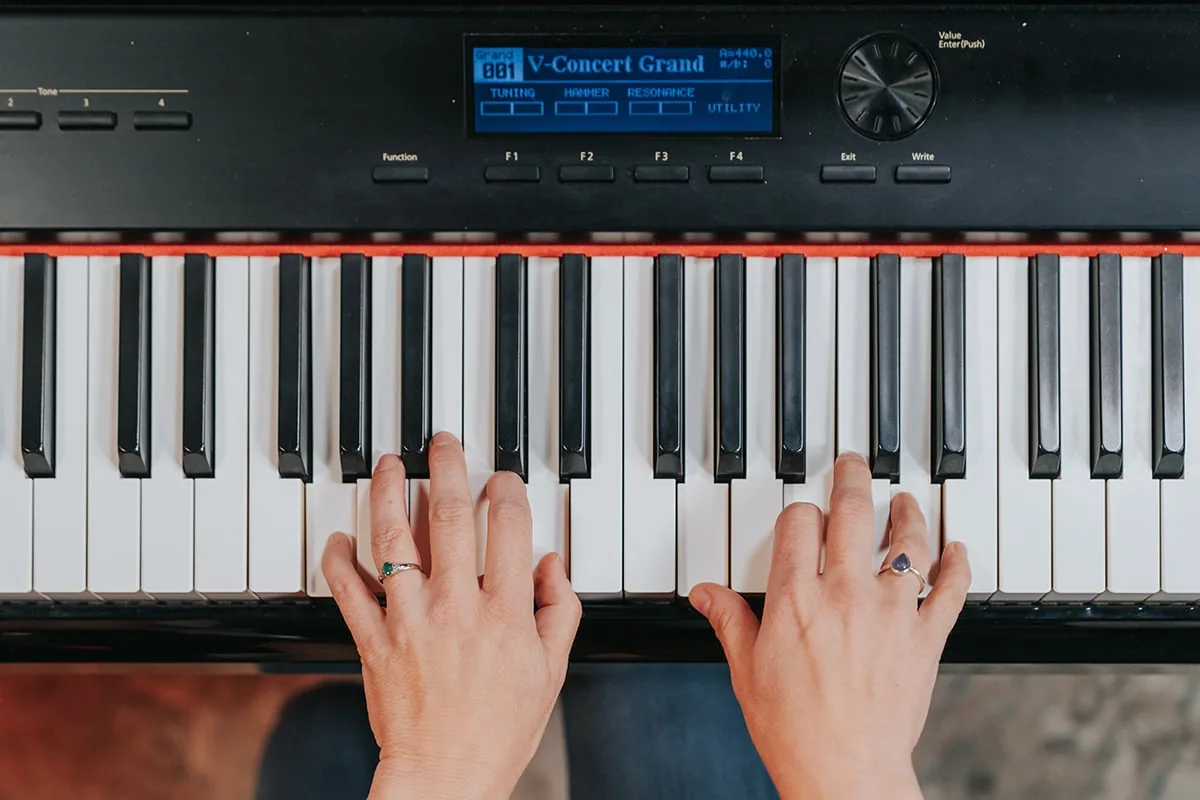
The G piano chord (G major) takes three keys: G, B and D — the root, major 3rd and perfect 5th. All of them are white keys, which makes it a great early one to learn. Play it with right-hand fingers 1-3-5, then try the 2 inversions below; you will meet it most in G major (I), C major (V) and A minor (VII).
Play it, or use Arpeggio to hear it note by note. Switch hands to see the fingering.
We build the G piano chord in root position (G B D), with fingering for both hands.
Same three notes, different note at the bottom. The G piano chord has 2 inversions, plus a two-hand voicing; when you move between chords, pick the one closest to where your hand already is.
The root, G, at the bottom — the standard shape.
B (the 3) is now the lowest note — a compact sound.
D (the 5) is now the lowest note — it leans forward, good for passing moments.
Left hand plays G low, right hand plays the chord — a fuller, more pianistic sound.
Getting to a chord in time matters more than holding it. Here is the shortest way into the G piano chord from C and Bm: keep the shared keys, move only what has to move.
From C (C E G), keep G where it is and move C down a half step to B and E down a whole step to D. That lands on the 1st inversion of G (B D G), so the hand barely moves.
From Bm (B D F♯), keep B and D where they are and move F♯ up a half step to G. That lands on the 1st inversion of G (B D G), so the hand barely moves.
G is stacked from the root up: G→B is a major 3rd (4 half steps), B→D is a minor 3rd (3 half steps). Together they make the 1–3–5 recipe shared by every major chord.
It sounds bright, settled and stable — the sound most songs come home to. Lower the third, B, by a half step to B♭ and it becomes Gm.
G belongs to 6 of the 24 major and minor keys. In G major it is the home chord (I). Tap a key to see its scale on the piano.
| Key | Numeral | Role in the key | Scale |
|---|---|---|---|
| G major | I | tonic (home chord) | See the scale |
| C major | V | dominant | See the scale |
| D major | IV | subdominant | See the scale |
| B minor | VI | submediant | See the scale |
| E minor | III | relative major | See the scale |
| A minor | VII | subtonic | See the scale |
The G piano chord sticks once you hear it in context. Tap a tile to hear it alone, or play the whole loop on piano.
The four-chord loop behind countless pop and rock choruses — bright, familiar and endlessly repeatable.
Borrowing the flat seventh chord gives a bold, Mixolydian rock sound that works great with power chords.
Starting on IV gives the four-chord loop an open, uplifting feel common in modern worship songs.
Five minutes a day at the piano is enough to make the G piano chord automatic. Run these four drills in order with a timer.
Find it without looking1 min
On the piano, G is the white key between the first and second of the three black keys. Look away, find it by touch, then drop fingers 1-3-5 onto G B D.
Walk the inversions2 min
With the right hand, walk the G piano chord through its inversions — G B D → B D G → D G B — and back down again. Go slowly and let your thumb find its key first on every move.
C ↔ G changes1 min
Alternate C and G: four beats each, then two, then one. Use the nearest inversion shown above and keep the shared keys down.
Hands together1 min
Left-hand little finger on a low G, right hand on the chord, both on beat one of every bar; then play the Pop axis loop (G–D–Em–C) at 100 BPM.
When the G piano chord sounds off, it is almost always one of these — each one tied to the actual piano keys it uses.
B is a white key. The black key just left of it, B♭, turns G into Gm — glance at that note before you press.
With only white keys it is tempting to flatten the hand. Keep fingers 1-3-5 curved as if holding a ball, and drop them together from the knuckles.
Lift the piano's sustain pedal as you play the next chord and press it again just after. Otherwise C and G smear together.
In the two-hand voicing the left hand plays only G. Keep it a little softer than the right hand, and don't double the third (B) down low — low thirds sound muddy.


Notes, difficulty, substitutes, keys and genres for G, answered.
After the G piano chord, open the next one: 12 roots × 7 types, each with diagrams and sound.