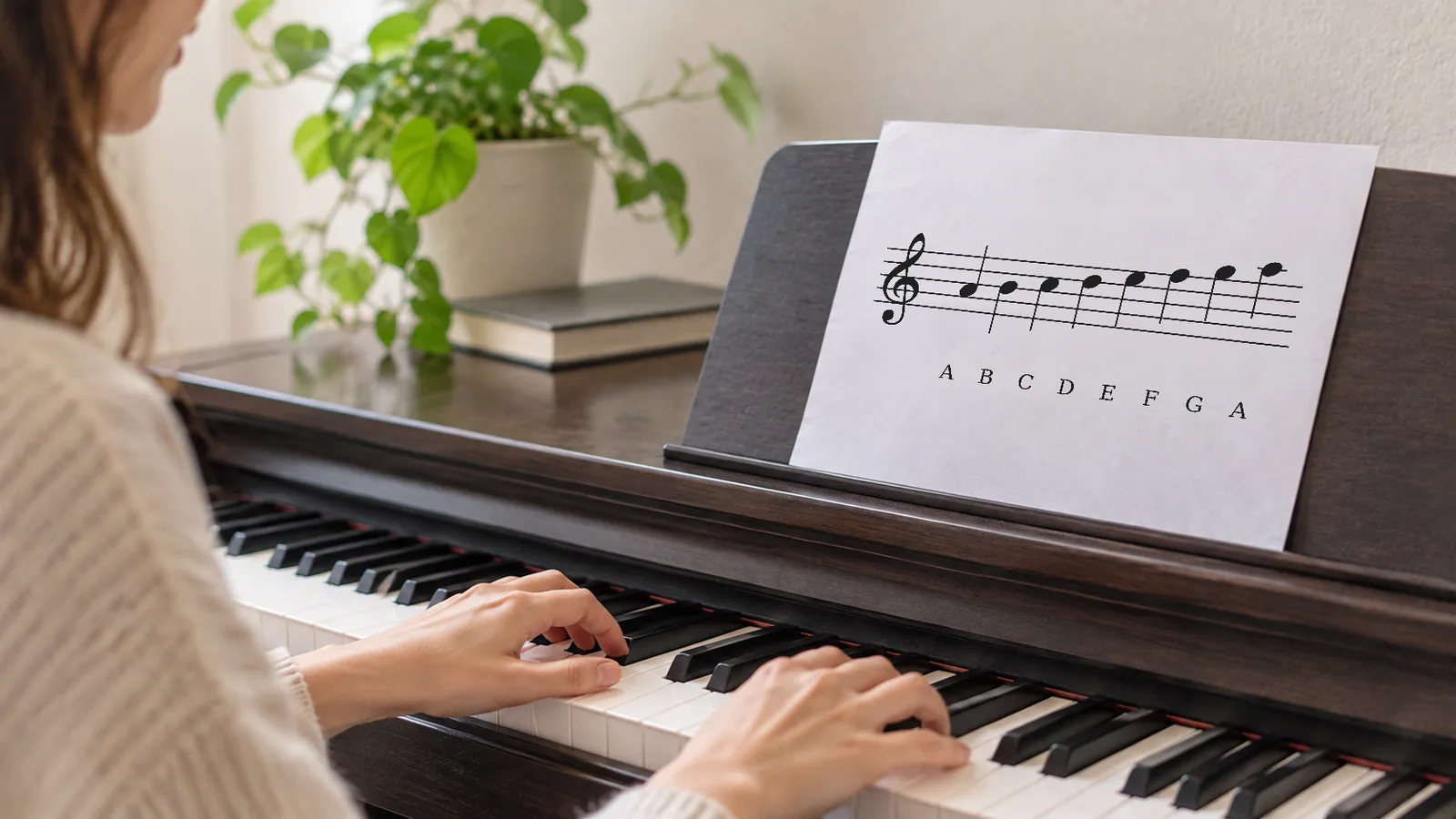
Middle C (C4)
Find the pair of black keys nearest the middle of the keyboard; middle C is the white key just to their left — key 40 of 88.
All 88 piano keys, labeled and playable. Tap any key to hear it and see its note name, octave and frequency, and learn how the piano keys are named — from A0 at the bottom to C8 at the top.
Tap any key to hear it and see its name, key number and frequency.
A standard piano has 88 keys: 52 white and 36 black. They cover seven full octaves plus a minor third, from A0 — the lowest A — up to C8. Every modern grand and upright uses this layout, and so do full-size digital pianos.
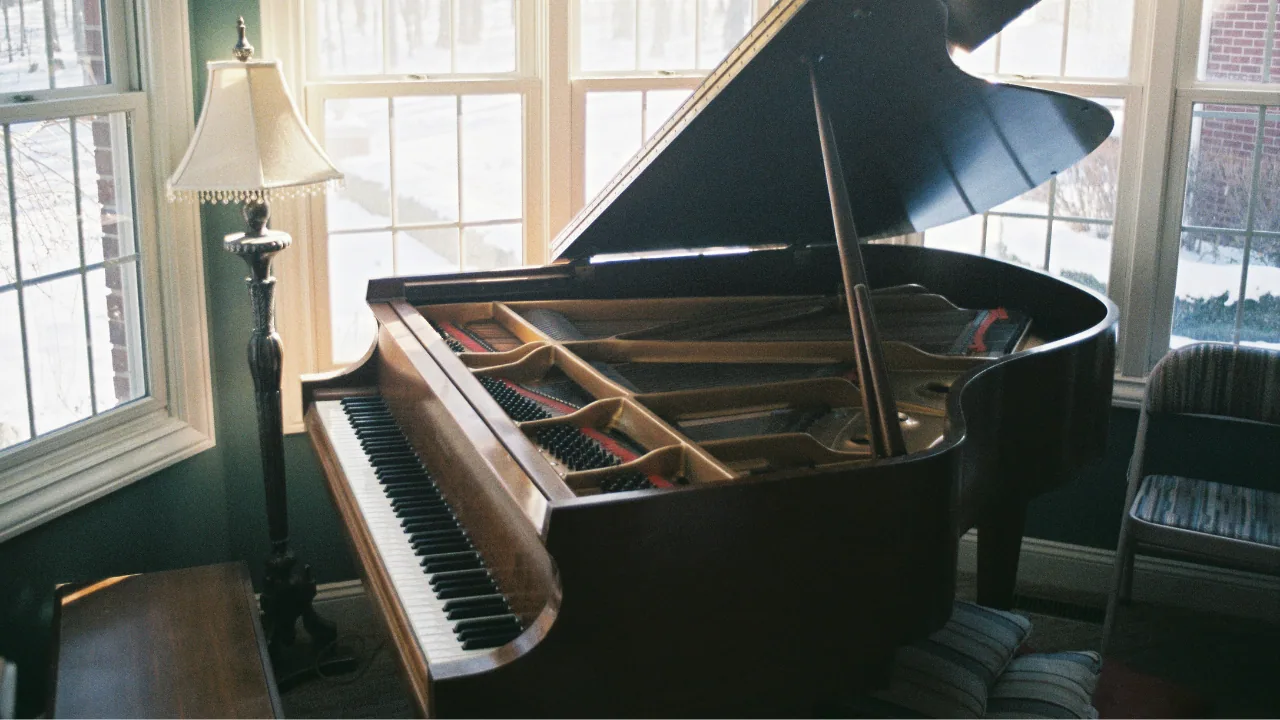
It was not always 88. Pianos from Mozart’s time had about five octaves; the range grew through the 1800s until makers settled on 88 piano keys in the late nineteenth century. A few concert grands go further — the Bösendorfer Imperial has 97, reaching down to C0 — while portable keyboards often have 61 or 76.
So how many keys on a piano should you learn? All of them follow the same 12-note pattern, so once you know one octave of piano keys you can find every note.

Piano keys are named with seven letters, A B C D E F G, which repeat all the way up the keyboard. The white notes carry those natural names; the black ones are the sharps and flats in between.
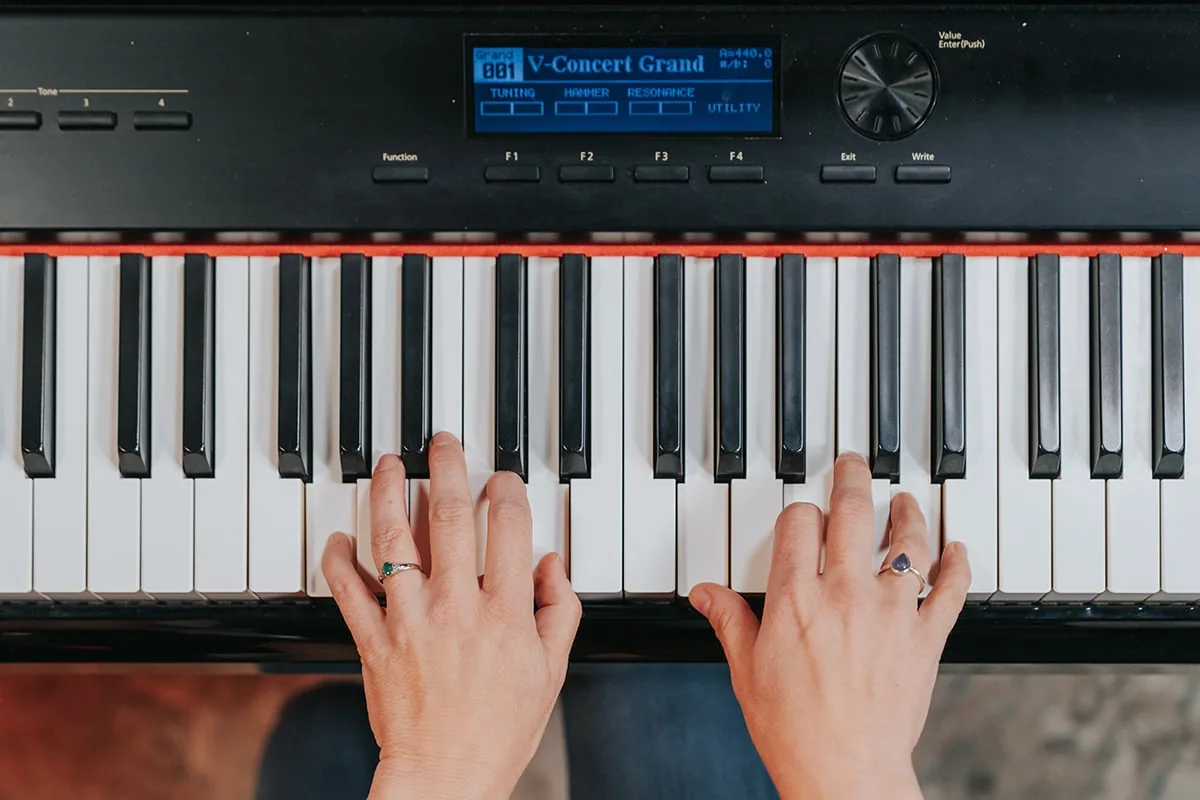
To find your way, look at the black keys: they come in groups of two and three. C is always the white key just left of a group of two, and F is just left of a group of three. Switch the labels above to “C only” and you will see the pattern repeat every octave.
A good exercise: turn the labels off, play every C on the piano from bottom to top, then every F, then every G. Within a few minutes you will find any note without counting.
Four piano notes worth finding without thinking. Try each one on the piano keys above before you read the answer.
Find the pair of black keys nearest the middle of the keyboard; middle C is the white key just to their left — key 40 of 88.
Count up the white notes from middle C: D, E, F, G, A. That A is key 49, the 440 Hz pitch orchestras tune to.
Go down an octave from middle C to C3 and find the group of three black notes above it: the first one is F♯3, also written G♭3.
C1 is the fourth white key from the left. Below it sit only A0, A♯0 and B0 — the three extra piano keys that make the total 88.
The piano keys are numbered by octave using scientific pitch notation. The octave number goes up at every C, so the notes run … A3, B3, C4, D4 … B4, C5. The lowest note, A0, sits below the first full octave; the highest is C8.
Middle C is C4, the fourth C from the left and key 40 of 88 — roughly in the middle of the keyboard, usually under the maker’s name. The tool highlights it, and the “Jump to middle C” button scrolls straight to it.
| Note | Key (of 88) | MIDI | Frequency | Landmark |
|---|---|---|---|---|
| C1 | 4 | 24 | 32.70 Hz | Lowest C |
| C2 | 16 | 36 | 65.41 Hz | — |
| C3 | 28 | 48 | 130.81 Hz | — |
| C4 | 40 | 60 | 261.63 Hz | Middle C |
| C5 | 52 | 72 | 523.25 Hz | — |
| C6 | 64 | 84 | 1046.50 Hz | — |
| C7 | 76 | 96 | 2093.00 Hz | — |
| C8 | 88 | 108 | 4186.01 Hz | Top note |
There are 12 different piano notes in every octave: 7 white and 5 black. Each step from one key to the very next — white or black — is a half step (semitone). A sharp (♯) raises a note by a half step and a flat (♭) lowers it, so the black key between C and D is both C♯ and D♭. Two names for one key are called enharmonic equivalents.
Between E and F, and between B and C, there is no black key: those white notes are already a half step apart. That gap is what creates the two-and-three pattern of the black piano keys.
Which name is correct depends on the key you are playing in. In D major the black key is written C♯; in A♭ major it is D♭. The piano chord finder and the piano scales pages always spell notes the right way for the chord or key.

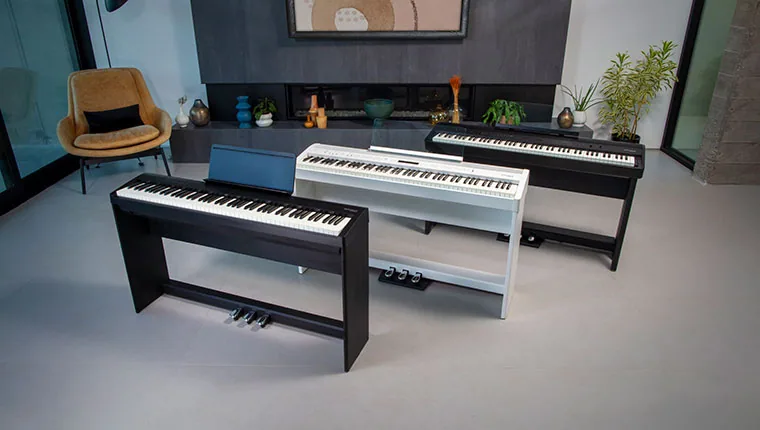
An 88-key piano gives you the full range and is the best choice for classical music or exams. 76 cover almost everything else, and 61 are enough for beginner lessons, chords and most pop songs. Smaller 49-, 37- and 25-key controllers are made for producing music on a computer.
If you are buying your first instrument, look for full-size, weighted or semi-weighted piano keys — the feel matters more than the last few notes at each end.

| Keys | Range | Typical use |
|---|---|---|
| 88 | A0 – C8 | Acoustic and digital pianos; plays the entire piano repertoire. |
| 76 | E1 – G7 | Stage pianos and arranger keyboards; most pop and much classical music fits. |
| 61 | C2 – C7 | Home keyboards and synths; enough for beginner lessons and most songs. |
| 49 | C2 – C6 | MIDI controllers for producers and songwriters. |
| 37 | C3 – C6 | Compact synths and small controllers. |
| 25 | C3 – C5 | Pocket MIDI controllers for laptops. |
Ten minutes a day is enough to know the piano keys by heart. Use the labels in the tool as training wheels and switch them off as soon as you can.

The same 88 piano keys on every grand, upright and digital piano — learn them once, play anywhere.





Turn the piano keys into chords, scales and songs.
Counting, naming and finding every note.
See which notes make every chord, or start with the easiest piano chords.