
Guitar Scales
Guitar scales for every key: major, natural minor, major and minor pentatonic and the blues scale, each drawn on the full fretboard with five positions you can tap and hear. Pick a root and a scale in the explorer, or jump straight to the guitar scales chart below.
Guitar scales explorer
A Minor Pentatonic Scale
Formula · 1½–W–W–1½–W
- Root
- Scale note
Guitar scales chart
60 guitar scales — five types in all 12 keys. Every card opens a page with the full-neck diagram, five positions, the chords of the key and audio.
Major scales
About the major scaleNatural minor scales
About the minor scaleMajor pentatonic scales
About the major pentatonic scale- Cmajor pentatonicC D E G A
- D♭major pentatonicD♭ E♭ F A♭ B♭
- Dmajor pentatonicD E F♯ A B
- E♭major pentatonicE♭ F G B♭ C
- Emajor pentatonicE F♯ G♯ B C♯
- Fmajor pentatonicF G A C D
- F♯major pentatonicF♯ G♯ A♯ C♯ D♯
- Gmajor pentatonicG A B D E
- A♭major pentatonicA♭ B♭ C E♭ F
- Amajor pentatonicA B C♯ E F♯
- B♭major pentatonicB♭ C D F G
- Bmajor pentatonicB C♯ D♯ F♯ G♯
Minor pentatonic scales
About the minor pentatonic scale- Cminor pentatonicC E♭ F G B♭
- C♯minor pentatonicC♯ E F♯ G♯ B
- Dminor pentatonicD F G A C
- D♯minor pentatonicD♯ F♯ G♯ A♯ C♯
- Eminor pentatonicE G A B D
- Fminor pentatonicF A♭ B♭ C E♭
- F♯minor pentatonicF♯ A B C♯ E
- Gminor pentatonicG B♭ C D F
- G♯minor pentatonicG♯ B C♯ D♯ F♯
- Aminor pentatonicA C D E G
- B♭minor pentatonicB♭ D♭ E♭ F A♭
- Bminor pentatonicB D E F♯ A
Guitar scales for beginners
Start with two guitar scales: a minor pentatonic box for soloing and a major scale in open position for melodies. Together they cover most beginner songs and solos — and teach you to read every diagram on this site.
A four-week plan for guitar scales
Fifteen minutes a day for four weeks, and the guitar scales on this page stop being diagrams and start being music.
- 1
Week 1: one pentatonic box
Learn A minor pentatonic box 1 at fret 5. Play it up and down at 60 bpm with alternate picking, then spend the last five minutes improvising over an Am backing track.
- 2
Week 2: the open-position major scale
Add G major in open position. Say the note names as you play and notice how the open G, D and B strings ring inside the scale.
- 3
Week 3: connect two positions
Join pentatonic box 1 to box 2 with a slide on the G or B string. Two connected boxes span about two octaves — enough for most solos.
- 4
Week 4: add the blue note
Add the ♭5 to box 1 to turn it into the A blues scale, then play over a 12-bar blues in A. You now have three guitar scales that cover rock, blues and folk.
How to practise guitar scales
Play guitar scales slowly with a metronome — one note per click at 60–80 bpm — using alternate picking (down, up, down, up). Go up and down the whole position without stopping before you speed up, and say the note names or degree numbers out loud.
Then make it music: play the notes in groups of three or four, skip strings, and improvise short phrases over the chords on each scale page. Once one position is solid, connect it to its neighbour and the neck starts to join up.
How to read guitar scale diagrams
The guitar scales here are drawn like tab: the thick low E string is at the bottom, the high E at the top, and fret numbers run underneath. Violet dots are the root, black dots are the other notes, and an outlined dot marks the blues ♭5. Switch the labels to degrees to see each note’s job.
A position is a window of four or five frets, one finger per fret. Tap any dot to hear it, or press play to hear the whole position.
Guitar scales for rock, blues, country and jazz

Each style has its favourite guitar scales. Rock and metal lean on the minor pentatonic and natural minor. Blues players live in the blues scale and slide between the minor and major pentatonic. Country and bluegrass pickers favour the major pentatonic and the major scale in open keys such as G, A and E, where open strings ring between fretted notes.
Jazz guitar starts from the same material, then adds modes such as Dorian and Mixolydian, melodic minor and an arpeggio for every chord. Whatever the style, the guitar scales on this page are the foundation the rest is built on.
Bass guitar scales
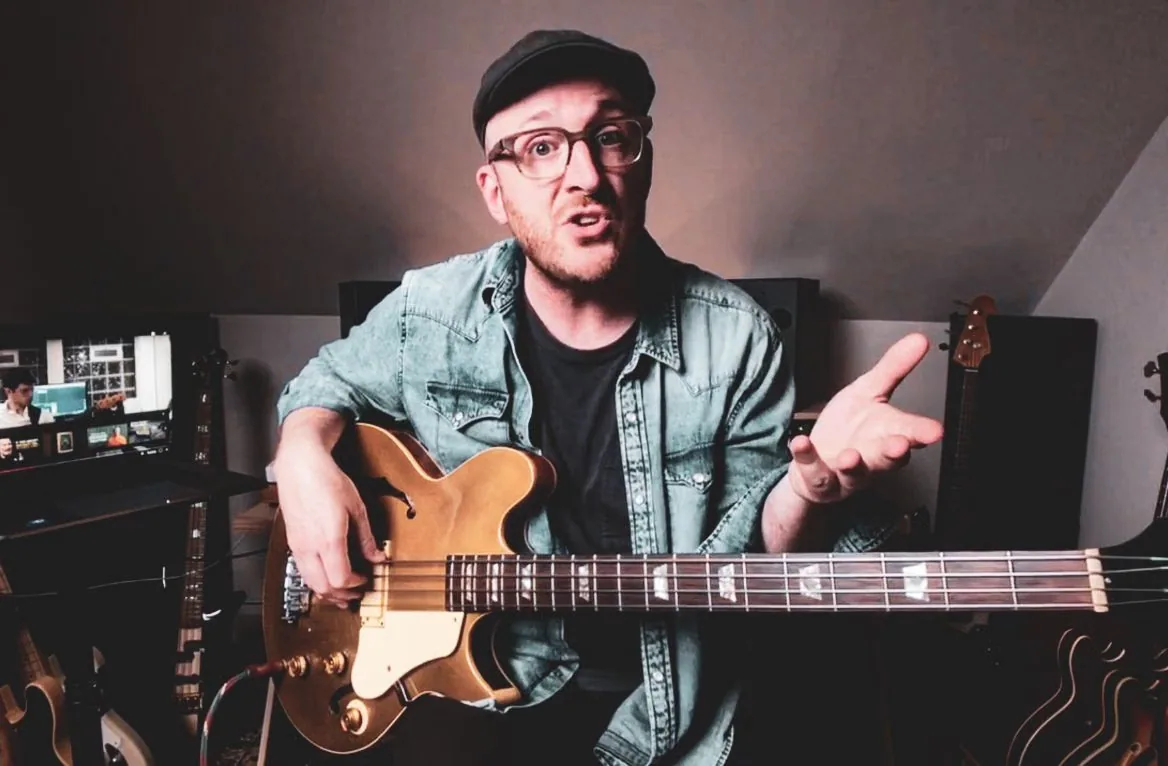
There is no separate bass fretboard here yet, but you don’t need one for scales: a four-string bass guitar is tuned E A D G — the same as the four lowest guitar strings, one octave lower. All the guitar scales on this site work on bass if you use the bottom four strings of the diagram.
“Short scale” on a bass or guitar refers to the string length (about 30 inches on a short-scale bass), not to a musical scale — the notes and patterns are exactly the same. For bass chord shapes, see the bass chord chart.
Common mistakes with guitar scales
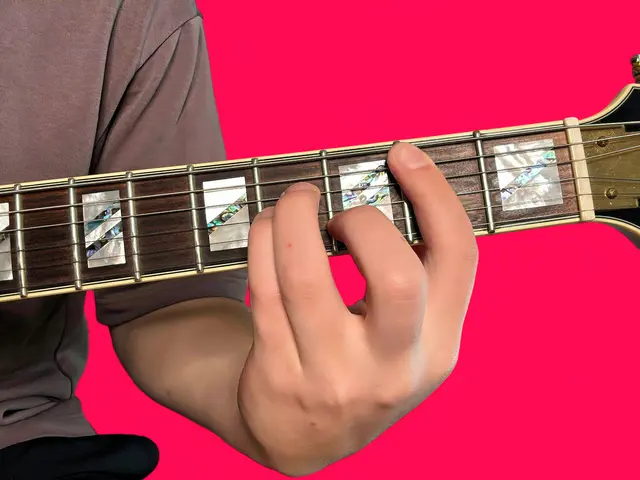
Practising too fast
Speed hides mistakes. If a note buzzes or a finger lifts far off the string at 100 bpm, drop to 70 and rebuild from there.
Learning dots, not notes
Know where the roots are in every position. Without them a box is just a pattern of dots, and you can’t move it to a new key.
Forgetting the picking hand
Most stumbles happen when the pick changes strings. Practise alternate picking slowly, and try economy picking once it is steady.
Never using them in music
Ten minutes of guitar scales is worth far more when the last two are spent improvising over a chord, a drone or a backing track.
Scale types explained
The five types behind these guitar scales — what each one is, how it sounds and where it is used.
Guitar scales in practice



Guitar Scales FAQ

What guitar scales should I learn first?
How many guitar scales are there?
What is the easiest guitar scale?
Are guitar scales the same on acoustic and electric guitar?
Do guitar scales work on bass guitar?
How long should I practise guitar scales each day?
Do I need to read music to learn guitar scales?
Which guitar scales are used in jazz?
Why learn guitar scales at all?
Scales are half the story
Find every chord that goes with your guitar scales — with diagrams and sound.