
E Minor Pentatonic Scale on Piano
The E minor pentatonic scale has five notes: E, G, A, B and D. It is the E natural minor scale without its 2nd and ♭6th (F♯ and C). On the piano every note is a white key. Hear it below, see it on a two-octave keyboard with a comfortable hand position, and play the chords that come from it.
E minor pentatonic scale on the piano keyboard
The E minor pentatonic scale over two octaves, starting on E. The root is violet. Tap any key to hear it, switch the dots between note names and degrees, and watch the keys light up as the scale plays.
Tap any key to hear it
- Root
- Scale note
E minor pentatonic scale piano fingering
There is no single standard fingering for the E minor pentatonic scale — method books differ, and that’s fine. A comfortable starting point for the right hand going up is 1-2-3, 1-2 per octave, so the thumb crosses under once in the middle and again at the octave. All five notes are white keys, so any comfortable grouping works — just keep the thumb crossing smooth.
Chords that fit the E minor pentatonic scale
The E minor pentatonic scale fits over the chords of E minor. Stack every other note of the E minor scale and you get seven chords: three major (G, C and D), three minor (Em, Am and Bm) and one diminished (F♯dim). Tap a chord to hear it on piano.
E minor pentatonic scale piano exercises
Four short piano drills using the fingering above — ten minutes a day is plenty.
- 1
Right hand in groups
Play E–G–A–B–D–E with the right hand grouped 1-2-3, 1-2 per octave, two octaves up and down at 60 bpm. All the notes are white keys, so the thumb can go anywhere — just keep the crossings smooth.
- 2
Left-hand drone, right-hand melody
Hold E and B in the left hand and improvise in the right using only E, G, A, B and D. Start with three-note phrases and end each one on E. Nothing will clash, so you can listen to the melody instead of worrying about wrong notes.
- 3
In octaves
Play the scale in right-hand octaves (thumb and little finger), up and down, keeping the wrist loose. Melodies from these five notes played in octaves are a staple of gospel, rock and film-score piano.
- 4
Broken chords: Em, Am, Bm
Play Em (E G B), Am (A C E) and Bm (B D F♯) as broken chords, right hand 1-3-5 and left hand 5-3-1. Most songs in E minor lean on these three chords, so the exercise doubles as accompaniment practice.

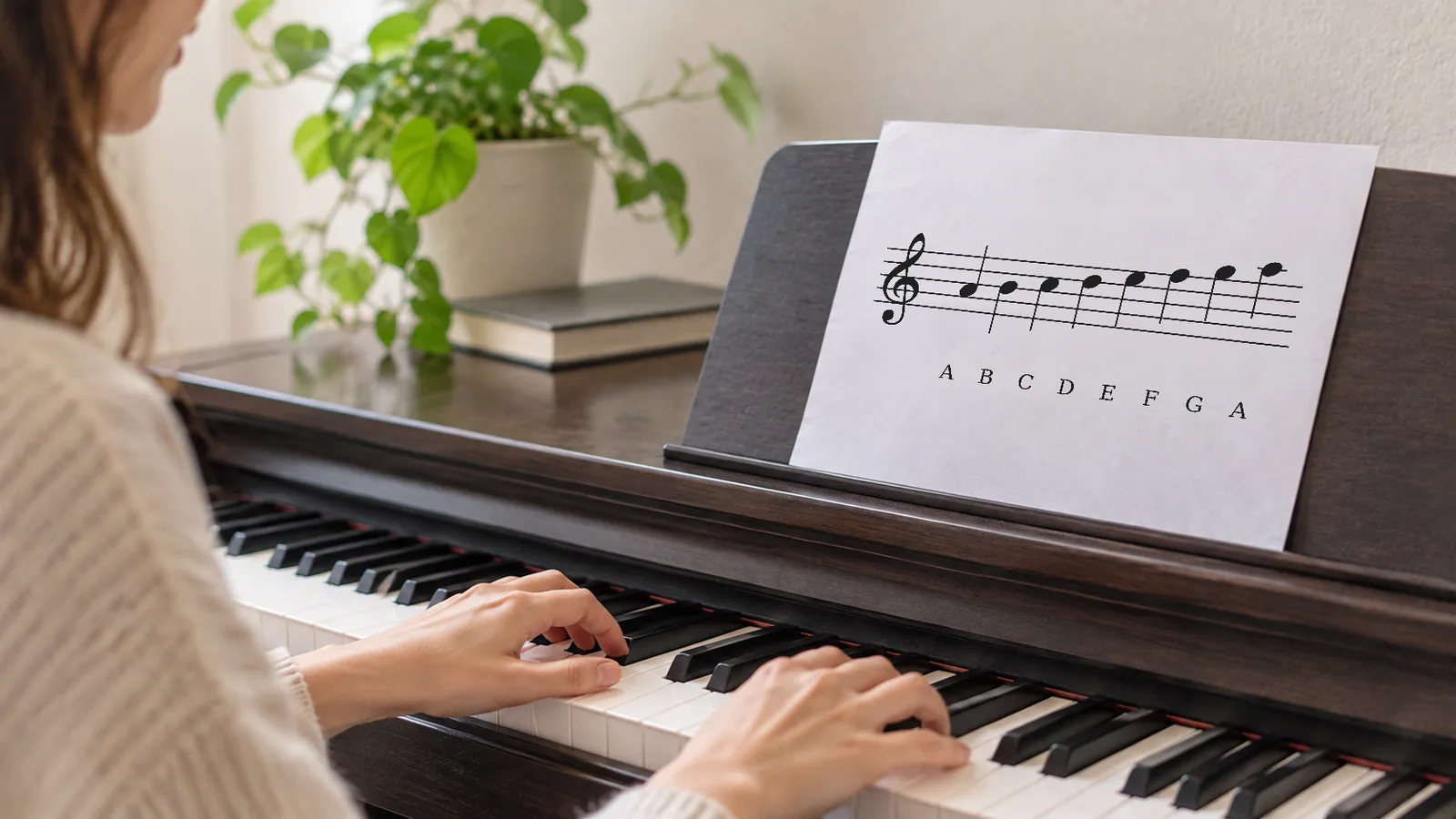



Common E minor pentatonic scale mistakes on piano
Three slips that hold most players back, and how to fix each one.
Sneaking the missing notes back in
The E minor pentatonic scale leaves out F♯ and C (degrees 2 and ♭6). Adding them by habit turns it back into the full E minor scale — fine when you mean it, but the open pentatonic sound disappears.
Hopping instead of gliding
All five notes are white keys, so it is tempting to hop the hand to each new group. Glide sideways instead and keep the wrist level.
Speeding up on the way down
Most players rush the descending half. Keep the metronome on and check that the top E lands exactly on a click — then the way down takes as long as the way up.
Improvising with the E minor pentatonic scale on piano
Every note of the E minor pentatonic scale fits over Em, Am and Bm, and over a 12-bar blues in E. End phrases on E or B; repeat a two- or three-note idea and change only its ending — the call-and-response trick behind countless rock solos.
Ear training: there are no half steps here, only whole steps and two 1½-step gaps (E–G and B–D). Sing along as the scale plays, then sing it back with the audio off — those gaps are what make it sound open.
How the E minor pentatonic scale is built
Every minor pentatonic scale follows the same step pattern: 1½–W–W–1½–W. Starting on E, that gives E – G – A – B – D – E.
The E minor pentatonic scale keeps degrees 1, ♭3, 4, 5, ♭7 of the E minor scale and leaves out F♯ and C (degrees 2 and ♭6) — the notes that form half steps with their neighbours. With only whole steps and minor thirds left, nothing clashes.
The E minor pentatonic scale and the G major pentatonic scale contain the same five notes — the only difference is which one feels like home.
Formula
W = whole step (2 frets / 2 keys), H = half step (1 fret / next key), 1½ = three half steps
| Degree | Note | Interval from the root |
|---|---|---|
| 1 | E | root |
| ♭3 | G | minor 3rd |
| 4 | A | perfect 4th |
| 5 | B | perfect 5th |
| ♭7 | D | minor 7th |
E minor pentatonic scale vs G major pentatonic and E minor
Relative scales share the notes but start elsewhere; parallel scales share the root but change some notes.
- This pageE Minor Pentatonic ScaleE G A B D1½–W–W–1½–W
- RelativeG Major Pentatonic ScaleG A B D ESame notes — home is G
- Parent scaleE Minor ScaleE F♯ G A B C DAdds F♯ and C
- Blues versionE Blues ScaleE G A B♭ B DAdds B♭
Where you’ll hear the E minor pentatonic scale
The minor pentatonic keeps five notes of natural minor — 1, ♭3, 4, 5 and ♭7 — and drops the 2nd and ♭6th. It is the backbone of rock and blues soloing: easy to finger and hard to play a wrong note with.
You’ll hear the minor pentatonic sound in blues, classic- and hard-rock solos, funk and R&B lines, metal riffs and hip-hop basslines.
Per octave it uses 5 white keys and 0 black keys. E is a favourite guitar key, so pianists who play with guitarists meet it all the time.

Related scales
The keys next door on the circle of fifths, the same scale on guitar, and the rest of the scale library.
E minor pentatonic scale FAQ
Quick answers about the E minor pentatonic scale on piano.
What notes are in the E minor pentatonic scale?
What is the fingering for the E minor pentatonic scale on piano?
How many black keys are in the E minor pentatonic scale?
What chords go with the E minor pentatonic scale?
Which major pentatonic has the same notes as the E minor pentatonic scale?
What is the difference between the E minor pentatonic scale and the E blues scale?
What is the difference between the E minor pentatonic scale and the E major pentatonic scale?
What are the modes of the E minor pentatonic scale?
How do I memorise the E minor pentatonic scale?
Turn E minor into a song
Generate chord progressions in E minor and hear them on piano, or find the key on the circle of fifths.