
1 / 7Standard shapeMedium
Barre at fret 2
3 fingers, one barre.
Frets3322
Barre at fret 23322
The Bmaj7 ukulele chord spells B–D♯–F♯–A♯: four notes, 1–3–5–7. There is no comfortable open version, so the standard shape is the barre at fret 2 (3322). Expect to see it in songs in B major (Imaj7), G♯ minor (IIImaj7) and F♯ major (IVmaj7).
Violet dots are the root. Numbers are fingers (1 index … 4 pinky); × = don’t play, ○ = open string.
These steps follow the standard 3322 shape of the Bmaj7 ukulele chord, barre first.
7 ukulele shapes, most useful first. Tap any card to hear it.
3 fingers, one barre.
4 fingers.
4 fingers.
4 fingers.
4 fingers.
3 fingers.
3 fingers.
Getting to a chord in time matters more than holding it. Here is how your fingers travel on the ukulele neck from F♯7 and D♯m into the Bmaj7 ukulele chord.
F♯7 and Bmaj7 share F♯ and A♯. Keep your middle finger on the G string, fret 3 — it stays put and guides the rest of the hand. The barre at fret 2 is the new part: lay it down first, then drop the other fingers.
D♯m and Bmaj7 share D♯, F♯ and A♯. The G string, fret 3 is in both shapes, so use it as your pivot. The barre at fret 2 is the new part: lay it down first, then drop the other fingers.
Bmaj7 is stacked from the root up: B→D♯ is a major 3rd (4 half steps), D♯→F♯ is a minor 3rd (3 half steps), F♯→A♯ is a major 3rd (4 half steps). Together they make the 1–3–5–7 recipe shared by every major 7th chord.
The major seventh sits just a half step below the root, and that soft rub gives the dreamy, jazzy colour. Bmaj7 is B major plus A♯; flatten that seventh to A and you get the bluesier B7.
Bmaj7 belongs to 4 of the 24 major and minor keys. In B major it is the home chord (Imaj7). Tap a key to see its scale on the piano.
| Key | Numeral | Role in the key | Scale |
|---|---|---|---|
| B major | Imaj7 | tonic (home chord) | See the scale |
| F♯ major | IVmaj7 | subdominant | See the scale |
| E♭ minor(C♭maj7) | VImaj7 | submediant | See the scale |
| G♯ minor | IIImaj7 | relative major | See the scale |
The Bmaj7 ukulele chord sticks once you hear it in context. Tap a tile to hear it alone, or play the whole loop on ukulele.
A mellow seventh-chord turnaround that loops smoothly under relaxed lo-fi beats.
The J-pop staple that climbs from IV to V and then falls to the minor chords — hopeful yet bittersweet.
The fundamental cadence of jazz harmony: minor 7th, dominant 7th, then a resolution to major 7th.
Five minutes a day beats an hour once a week. Run these four drills in order and the Bmaj7 ukulele chord will soon land cleanly on the first try.
Barre on its own1 min
Press only the barre at fret 2 and pick each string under it. Roll the finger until every one rings, then add the rest of the shape.
Lift and land1 min
Fret Bmaj7, strum once, lift your hand an inch off the strings and land the shape again — ten times in a row. Aim for all three fingers to touch down together.
F♯7 ↔ Bmaj7 changes2 min
Alternate F♯7 and Bmaj7: four strums each, then two, then one. Keep your middle finger on the G string, fret 3 — it stays put and guides the rest of the hand.
Play it in a loop1 min
Play the Lo-fi jazz loop above (Bmaj7–G♯m7–C♯m7–F♯7) at 75 BPM; once it feels easy, add 10 BPM.
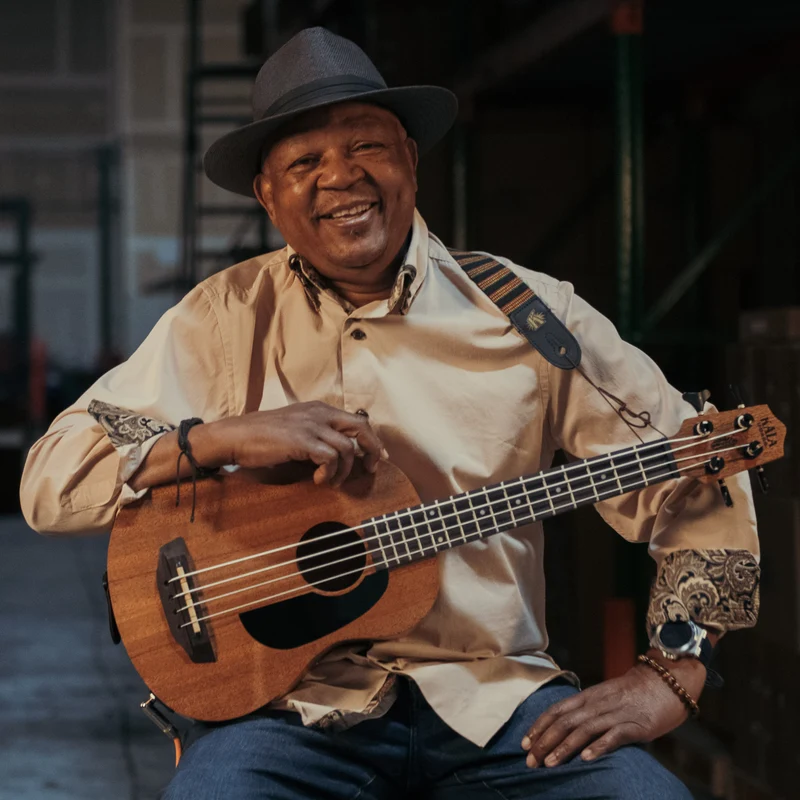
If your Bmaj7 ukulele chord doesn't sound right, check these first — each one is based on the standard 3322 shape.
The major 7th, A♯ on the G string, fret 3, sits a half step below the root and makes the soft rub you hear. One fret lower and you have B7, a more restless chord.
The G string is tuned high, so the lowest note of Bmaj7 on ukulele is D♯ on the C string, not the root. That is normal: strum all four strings.
Most buzz in the 3322 shape comes from the barre at fret 2. Keep your index finger right behind the fret wire, roll it slightly onto its bony edge, and keep the thumb behind the ukulele neck rather than over it.

Notes, difficulty, substitutes, keys and genres for Bmaj7, answered.
After the Bmaj7 ukulele chord, open the next one: 12 roots × 7 types, each with diagrams and sound.